Showing posts with label instant noodles. Show all posts

Sunday, September 22, 2024

Indonesia's Instant Noodles Market: Growth, Trends, and Global Appeal

The instant noodles market in Indonesia is one of the largest and most dynamic in the world, reflecting the country’s unique culinary preferences and broader economic trends. As of 2023, Indonesia consumed approximately 14.54 billion servings of instant noodles, making it the second-largest consumer globally, behind only China. This massive consumption is driven by several key factors, including the convenience, affordability, and diverse flavors that make instant noodles an appealing option for millions of Indonesians.

At the heart of Indonesia’s instant noodles industry is Indomie, a brand owned by Indofood, which has become a household name across the country. Indomie’s dominance in the market can be attributed to its extensive product range, catering to a variety of local tastes with flavors such as Mi Goreng, Rendang, and Soto. The brand’s ability to innovate while staying rooted in Indonesian culinary traditions has helped it maintain a loyal customer base. In addition to its product range, Indomie’s strong marketing strategies, including celebrity endorsements and strategic sponsorships, have solidified its presence in the market. During the COVID-19 pandemic, demand for instant noodles surged as people sought easy-to-prepare meals, further boosting Indomie’s sales.

The Indonesian instant noodles market is segmented into cup/bowl noodles and packet noodles, with the latter being more popular due to their affordability and versatility. Packet noodles are a staple in many Indonesian households, often combined with vegetables, eggs, or protein to create a more substantial meal. This versatility allows consumers to adapt the product to their personal preferences and nutritional needs, making packet noodles an enduring favorite.

The market has also seen substantial growth in exports, with Indonesia exporting significant quantities of instant noodles to countries such as Malaysia, Australia, and the United States. This expansion underscores the global appeal of Indonesian instant noodles, which are now enjoyed by millions of people worldwide.

Looking ahead, Indonesia’s instant noodles market is expected to continue growing, driven by factors such as rapid urbanization, rising disposable incomes, and an increasing preference for convenient food options. As more Indonesians lead busy urban lifestyles, instant noodles offer a quick, satisfying meal option that fits into their fast-paced routines.
Indonesia's Instant Noodles Market: Growth, Trends, and Global Appeal

Wednesday, January 12, 2022

Production of instant noodle

Noodles are long thin piece of food made from a mixture of flour, water and eggs usually cooked in soup or boiling water. An instant noodle is a food item made from unleavened dough that is made from different types of ingredients.

According to Codex definition, instant Noodle is a product prepared from wheat flour and/or rice flour and/or other flours and/or starches as the main ingredient, with or without the addition of other ingredients. It may be treated by alkaline agents. It is characterized by the use of pre-gelatinization process and dehydration either by frying or by other methods.

Instant noodles appeared to have originated in Japan in the 1950s and today, are consumed in more than 80 countries, become internationally recognized food. Noodle industry supplies 95.4 billion servings annually to consumers throughout the world, and the demands are on the rise.

Instant noodles are made from wheat flour, starch, water, salt or kan sui (an alkaline salt mixture of sodium carbonate, potassium carbonate, and sodium phosphate), and other ingredients that improve the texture and flavor of noodles.

The properties of instant noodles like taste, nutrition, convenience, safety, longer shelf-life, and reasonable price have made them popular. Quality factors important for instant noodles are color, flavor, and texture, cooking quality, rehydration rates during final preparation, and the presence or absence of rancid taste after extended storage. Instant noodles can then help in shortening preparation times and produce good quality results, while maintaining nutritional values.

Instant noodles are classified into two types on the basis of methods used for the removal of moisture, i.e., instant dried noodles and instant fried noodles.

Instant dried noodles are produced in a fully automatic production line similar to the type used for steamed and deep-fried noodles, except that a continuous drying chamber replaces the deep fryer, using hot air as the drying medium.

Frying the noodles in oil at 140-160 ºC for 1-2 minutes decreases the moisture content of noodles to about 2–5%, whereas in hot air-dried noodles, it is about 8–12%.

While any edible oil is suitable for frying, palm oil or palm olein is often used in Asia and mixtures of canola, cottonseed, and palm oils are commonly used in North America. The process leads to shrinkage and raises the level of porosity and roughness. The moisture contained in the gelatinized starch granules evaporates due to the high temperature. The empty spaces previously occupied by the moisture are next partially filled with oil

In hot air drying, the noodles are held at 70-90 ºC for 30-40 minutes to achieve an 8-12% moisture content.

The heating during frying or hot air drying further gelatinizes the starch and the noodles attain a porous texture, which facilitates rehydration process while cooking the product.

Instant noodles are commercially available in two packaged forms - in a cup with the seasoning sprinkled over the noodles or in a pouch (or bag) with the seasoning provided in a sachet inside the pouch.
Production of instant noodle 

Monday, January 13, 2020

When was instant noodle introduced to the United States?

The instant noodle originated in 1958 in Japan. Ando Momofuku’s inspiration behind the cupped version of instant ramen was his desire to export instant noodles to the United States and Europe.

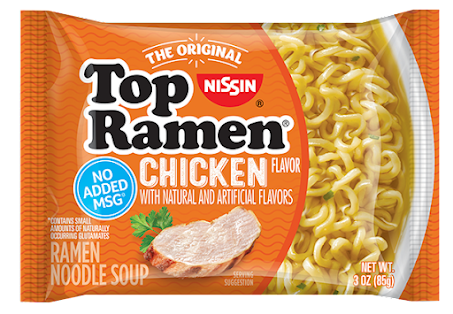
In 1970 Nissin formed a US subsidiary to sell instant noodles to the Americans, which began importing bagged ramen from Japan and sold it in the United States under the brand name Top Ramen.

The company began producing “Cup o’ Noodles” in California at the same year and gained acceptance of ramen noodles as a snack/light meal among American consumers. In 1972, Nissin Foods introduced "Nissin Cup Noodles" in a foam food cup, which led to an upsurge in popularity.


Maruchan, the best selling ramen noodle bran in the United States, started out as a frozen fish distributer in Japan. In 1972, the Maruchan division of Toyo Suisan Kaisha opened its first instant ramen production facility in the United States: by 1997 it had three factories.
When was instant noodle introduced to the United States?

Wednesday, August 01, 2018

Japanese and noodles

The use of flour, introduced from China during the Middle Ages (end of the twelfth century to the end of the sixteenth century) took firm root in Japan, making noodles a food with an importance comparable to rice, the staple food of the Japanese diet.

The Japanese-style noodles are made with low-protein flours from soft wheats, and salt whereas the Chinese noodles use higher-protein flours from hard wheat, and are made using a mixture of potassium carbonate and sodium carbonate. Japanese noodles have been developed over the years using domestic wheat, and such products have long been accepted by the Japanese.

The history of noodles in Japan begins with Zen priests represented by Eisai (1141–1215), founder of the Rinzai school of Zen Buddhism, and Dogen (1200–1253), founder of the Soto school of Zen.

Introduced in 1958 by Sanshī Shokuhin of Japan (later renamed the Nissin Foods Corporation), instant noodles quickly became a favorite of the postwar Japanese baby boomer generation.

Clearspring Organic Soba and Udon noodles are satisfying and versatile foods. Noodle process behavior is particularly important in the modem industrial production. Each noodle type has its own unique color and texture characteristics. Flour color, protein content, ash content, yellow pigment and polyphenol oxidase activity are important factors responsible for noodle color.
Japanese and noodles

Saturday, March 17, 2018

Instant noodles and cardiometabolic syndrome

The prevalence of cardiometabolic risk factors is rapidly increasing in South Korea. One of the main driving forces for increased cardiometabolic risk factors could be unhealthy dietary choices, including increased consumption of fast food (The Journal of Nutrition, Volume 144, Issue 8, 1 August 2014, Pages 1247–1255).

Increased consumption of instant noodles has recently been reported to be positively associated with obesity and cardiometabolic syndrome in South Korea, which has the highest per capita instant noodle consumption worldwide (Nutr Res Pract. 2017 Jun; 11(3): 232–239. Published online 2017 May 24).

Analysis from KNHANES IV (2007–2009) demonstrated that the consumption of instant noodles two or more times per week was associated with a higher prevalence of metabolic syndrome in women (OR: 1.68; 95% CI: 1.10, 2.55) and that this association was independent of major dietary patterns (Shin H.J., Cho E., Lee H.J., Fung T.T., Rimm E., Rosner B., Manson J.E., Wheelan K., Hu F.B. Instant noodle intake and dietary patterns are associated with distinct cardiometabolic risk factors in Korea. J. Nutr. 2014;144:1247–1255).

Metabolic syndrome is the name for a group of metabolic disorders including hyperglycemia, hypertension, dyslipidemia, and obesity, particularly abdominal obesity. Uncared metabolic disorders are associated with the increased risk of various chronic diseases related to insulin resistance (IR) such as diabetes, cardiovascular diseases (CVDs), cancer, dementia, and non-alcoholic fatty liver disease.

Hypertension is a core feature of cardiometabolic syndrome and diabetes is a common consequence. Metabolic syndrome is related to the basic pathophysiologic processes underlying atherosclerotic cardiovascular disease (CVD) and type 2 diabetes and is an important epidemiological measure allowing for the identification of individuals at high risk for developing these conditions.
Instant noodles and cardiometabolic syndrome

Wednesday, September 16, 2015

Seasoning for instant noodles

The majority of Asia style noodles are consumed as soup. Instant remain noodles have become synonymous with convenience foods, and consumers have come to expect a certain consistency in the product, both in flavor and texture.

There is instant noodles being sold in Styrofoam cups and packets, Some instant noodles can be eaten when added hot water into the cup containing the dry noodles while instant noodles in packets need to be cooked.

One of the key components of the success of these instant noodles is the spice seasonings that provide a consistent flavor balance.

Noah Webster’s original 1828 edition of the American Dictionary defined the word seasoning as ‘that which is added to any species of food to give it a higher relish; usually something pungent or aromatic, as salt, spices or other aromatic herbs, acids, sugar or a mixture of several things.’

Some compounds may be part of a seasoning mix at one time, and a complete condiment at another time, depending on when and how they are used.

The flavors of most spices are due to the presence of volatile organic compounds. In some cases, non-volatile organic components contribute to the flavor.
Seasoning for instant noodles

Saturday, October 20, 2007

Instant Noodles

Instant Noodles are probably one of the greatest inventions of all times. The strange thing is that they really are not instant and really are not a new invention. They are just the same old noodles in a new package and marketed a little differently.

There has to be a lesson to be learned when this product is given a closer inspection. Here is something (The noodle) that is hundreds or even thousands of years old. Yet it is now one of the most profitable food niche markets in existence today. Whether it is ramen, canton, bihon, pancit or whatever name it is known by locally, the concept is actually very amazing.

Anyone can purchase these same noodles for much cheaper if they buy them in bulk; bulk in this case being buying them by the kilo or by the pound. Throw in a little bouillon cube and voila, instant success.

So what is the lesson to be learned here from this marketing wonder? Is it that everybody needs to find a product that is hundreds or thousands of years old? That is hardly the case. The whole point is that anything can be sold and profited on if it is packaged correctly.

Who was the first one who packaged the noodles in portions that were suitable for one person? While nobody may know their name, it is certain that it could be looked up. Either way, if they patented the idea, there is a strong chance that they are not among the working class people anymore.

Somebody once said that everything worth being invented has already been invented. This is probably not the case either. The sad fact of the matter is that most people will not ever come up with a patent able idea that will allow them to retire in the lap of luxury.

The whole idea behind marketing; whether it is marketing an idea, a product or information on the internet, or providing something tangible in a store; the concept is the same. Marketing and recognizable packaging has a lot to do with it but it is mostly in the presentation.

These people offered nothing at all that was new. They repackaged it and advertised it as a convenience. Given the hectic pace in the world today, that concept is what sold the product. They knew what buttons to push to get people to buy.

It can be said that not everybody is going to have a life changing idea or concept. That does not mean that they cannot get rich with the proper marketing. Finding a product that can be sold is an important factor. Creating a need or a desire is important to success as is creating a sense of urgency to have that one product in particular. Closing the deal is easy when everything is packaged and presented properly. Making sure that the product is easily recognizable will generate return business, but that is another article.

The Most Popular Posts

Articles from around the world