Showing posts with label buckwheat. Show all posts

Wednesday, December 22, 2021

Naengmyeon noodles

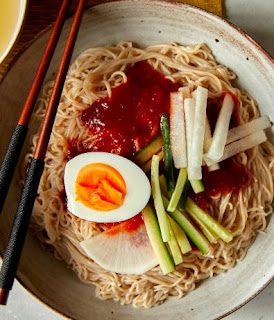
Naengmyeon (Korean traditional cold noodles), a representative Korean food that is popular in summer, consists of broth and long thin noodles made of kudzu or buckwheat, and it is also served with pieces of sliced cucumber, pear, meat, and boiled egg.

The broth was made with Dongchimi (radish water kimchi) brine scooped out of the earthenware crock which was half-buried in the ground for winter storage.

In North Korea, Naengmyeon noodle is served in a stainless-steel bowl in icy cold water leading to its the western name ‘Cold Noodles’.

People usually eat hot noodles on cold days and cold noodles on hot days. However, in accord with the traditional Korean saying “beat the heat with heat and the cold with cold, Koreans often eat cold noodles in winter and hot noodles in summer.

Naengmyeon can be roughly divided into 2 types:
*Mulnaengmyeon, a type of naengmyeon that adds cold broth to noodles, and
*Bibimnaengmyeon, a type that adds condiment mix to noodles.

Buckwheat was introduced by the Mongol Empire during the Goryeo Dynasty (founded in 918). Therefore, it was said people living in the mountainous northern region first began eating it around that time. Naengmyeaon noodles already available since the Joseon Dynasty (1392-1897), the delicacy only made for nobility and the rich since only they had an access to ice in summer. The rich had reserves and stored of ice in their very own caves.

Mulnaengmyeon is sold in the form of instant food, and it is a growing market in Korea. Instant mulnaengmyeon was first introduced to the market in 1968.
Naengmyeon noodles
Thursday, September 23, 2021

Buckwheat

Buckwheat noodles are mainly sold in the form of fresh and dried noodles in China. Buckwheat noodles are usually a combination of 70 percent hard wheat flour, 30 percent buckwheat and 28 percent water. The paste extruded directly into boiling water.

Buckwheat flour is gluten-free which makes it a good choice for anybody with gluten sensitivities or celiac disease. Buckwheat is not a cereal grain but it is actually a fruit seed that is related to rhubarb and sorrel. It is packed with nutrients and has a nice nutty flavor.

Buckwheat is an annual plant of Polygonaceae family with no relation between grains. It belongs to the group of buckwheat pseudo-cereals, that has different and identical characteristics like grains such as wheat, rice and barley.

The grain is generally used as human food and as animal or poultry feed, with the dehulled groats being cooked as porridge and the flour used in the preparation of pancakes, biscuits, noodles, cereals, etc.

Buckwheat is recognized as a good food source which is nutritionally valuable due to the content of protein, lipid, dietary fiber, and minerals, and in combination with other health-promoting components. The protein of buckwheat is of excellent quality and is high in the essential amino acid lysine, unlike common cereals.
Buckwheat

Friday, November 29, 2019

Characteristics of buckwheat noodles

Though some Asian-style noodles are wheat-based, many others are made from ingredients such as rice flour, potato flour, buckwheat flour, corn flour and bean, yam or soybean flour.

Buckwheat flour is gluten-free which makes it a good choice for anybody with gluten sensitivities or celiac disease. Buckwheat is not a cereal grain but it is actually a fruit seed that is related to rhubarb and sorrel.

Noodles containing buckwheat are called soba. These noodles are typically light brown or grey in colour with a unique taste and flavour. Soba noodles are native Japanese noodles made of buckwheat flour. Like pasta, soba noodles are available in dried form in supermarkets, but they taste best if freshly made by hand from buckwheat flour and water.

Buckwheat noodles, or soba, are long, thin, brownish noodles made from a composite of buckwheat flour (soba-ko) and wheat flour(komugi-ko). They have a unique flavour and texture and are served plain or in soup.

Soba is particularly favored for its flavor and texture and the nutritional advantages associated with its rich protein, mineral, and functional contents, including rutin. Buckwheat flour contains about 10% protein by weight.
Characteristics of buckwheat noodles

Sunday, October 30, 2016

Buckwheat noodles

Buckwheat flour has very little binding starch and is traditionally made with grated yamaimo, and Asian yam that exudes a lot of mucus.

Even then, the dough is difficult to roll out and cut. Buckwheat noodles are usually a combination of 70 percent hard wheat flour, 30 percent buckwheat and 28 percent water. The paste extruded directly into boiling water.

Salt is not used because of the low water content and to avoid changing the flavor of the noodle.

Buckwheat noodles are thin and brownish gray in color. They are popular in Japanese cuisine. They are wholesome and slightly chewy in texture and are eaten hot, at room temperature or cold.

When served as a course in itself, boiled buckwheat noodle is arranged on a bamboo lattice set in a square bamboo or wooden frame.
Buckwheat noodles

Friday, December 19, 2008

Japanese Noodle

Japanese Noodle
During the heat summer, Japanese noodles wonderfully refreshing when serve floating in a bowl of ice water and accompanied by a chilled dipping sauce. In winter, noodles are commonly served in hot, shoyu-season broth. Whether in soups or salads, sautéed with vegetables, baked or topped who the sauce, noodles are always delicious.

Although there are many varieties within each type, there are two main categories of Japanese noodles: those made from buckwheat (soba) and those made from wheat (udon and somen). Because buckwheat requires cooler, drier growing conditions, the thin brownish gray soba noodle is mostly popular in northern Japan. Natural foods stores and Asian markets offer a wide variety of soba noodles.

One hundred percent buckwheat soba is a hearty, delicious, wheat free noodle that comes in salt free and salted varieties. Most soba noodles are made from 40 to 80 percent buckwheat flour, with the reminder being unbleached white flour. Ito soba, which contains 40 percent buckwheat flour, is a thin, delicate, noodle that cooks quickly and easily absorbs the flavor of broths, sauces or seasonings.

Udon is a thick, chewy, beige wheat noodle that resembles linguine and is favored in Kyoto and southern Japan. The varieties sold in natural foods stores are made from 100 percent whole wheat flour, or a combination of whole wheat and unbleached white flour.

One hundred percent whole wheat udon is a sturdy noodle with a robust whole wheat flavor and textured appearance. For a noodle that will readily absorb the flavors of broths, sauces and seasonings, use lighter, smoother udons – typically those made with some unbleached white flour. Brown rice udon, a combination of brown rice and wheat flour, is not a traditional Japanese food, but rather was developed especially for the natural foods market.

Though Japanese noodles are well suited to a variety of cooking styles and preparations, it is important to choose the right noodle for the dish to be prepared. For example, while soba and udon are excellent choices for stir-fried noodles, thin, delicate varieties of soba, such as ito and cha soba, are not recommend for frying, and 100 percent soba is also a poor choice. Somen, a thin wheat noodle is too delicate for frying.
Japanese Noodle

The Most Popular Posts

Articles from around the world