Showing posts with label yellow alkaline noodle. Show all posts

Sunday, April 16, 2023

Characteristics of yellow alkaline noodles

Noodles can be classified as white (containing salt) or yellow (containing alkaline salt), depending on the absence or presence of alkaline salt in the formula. Yellow alkaline noodles are of considerable importance owing to their brightness and yellow color tone. They are famous in South East Asia and now taking share in other parts of the globe too.

Asian customers prefer bright yellow alkaline noodles that retain a stable color for 24–48 hour after preparation and perceive red or dull grey colors as undesirable.

Noodles nutritional quality depends on wheat quality, basic flour specifications, ingredient functions, and production variables according to the type of noodles process. Yellow alkaline noodles are prepared from wheat flour along with water and alkaline salt as their basic ingredients and are usually parboiled. In this regard, noodles prepared with the addition of egg (wantan noodles) are also popular which are parboiled using steam and dried.

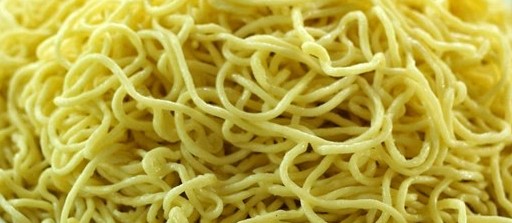
The noodle properties are firm, chewy, springy texture and bright yellow appearance due to the natural flour flavonoid pigments at alkaline pH. Yellow noodles are typically made by adding alkaline salt to the ingredients. The alkaline salt added imparts the unique features of Chinese noodles with pH 9.0-11.0 , whereas the yellowness of the noodles is produced when the flavones react with the alkaline water.

Yellow alkaline noodles are usually sold in wet form containing moisture contents in the range of 50–60 % (final product). Chinese noodles are made from wheat flour that should contain protein contents in the range of 10–13 % but preferable protein contents are in the range 11–12 %.

In the interior of alkaline noodles, the inherently low-swelling starches of hard wheats are further restricted from swelling by the carbonate salts. The alkaline salts toughen the dough, affect the pasting properties of starch by retarding gelatinization and increasing paste viscosity, inhibit enzyme activity, and suppress enzymatic darkening.

Flour used for yellow alkaline noodles usually contains 11.0–13.5 % proteins. The gluten proteins constitute∼ 80 % of proteins present in wheat flour. They are further comprised of two districts types, that is, gliadin and glutenin. The gliadin fractions are important in formation of disulfide bonds thus rendering firmness against aggregate formation, while glutenin are elastic in nature.

High quality yellow noodles should be free from discoloration, having symmetrical dimensions, should not be sticky after being cooked, as well as showing sufficient firmness and springiness.
Characteristics of yellow alkaline noodles
Friday, January 15, 2016

Texture characteristics of alkaline noodles

Inclusion of alkaline salts in noodle formulas imparts a characteristics aroma and flavor, a yellow color and a firm, elastic texture.

Alkaline agents improve the texture of the cooked product, making it more chewy with less of a tendency to soften and paste after cooking.

The desired textural characteristics are a bright, even light yellow appearance; free of any darkening or discoloration; a firm clean bite; a chewy and elastic texture with some degree of springiness; and a satisfactory al dente reaction on biting.

Alkaline noodles prepared with NaOH are sticker and less firm than alkaline noodles made with blends of sodium and potassium carbonate, possibly NaOH adversely affects gluten development.

In addition, the starch characteristics (amylose/amylopectin ratio) seemed to play an important role in altering the texture of noodles.
Texture characteristics of alkaline noodles

Tuesday, December 01, 2015

Yellow alkaline noodles ingredients

Yellow alkaline noodles are essentially made from flour (100 parts), water (32 – 35 parts), and a solution of alkaline salts known as kansui or lye water (1 part).

The most common of salts are usually a mixture of sodium and potassium carbonates (typically 9:1) or sodium hydroxide in some cases. The application of alkaline salt in noodle making is originated in southern China. In ancient times, kansui was extracted by boiling lye stone or plant ash in water.

Noodles supplemented with high alkali levels have stronger flavor and coloration because flavones react with the alkaline salts.

Flours from hard wheat, with protein content in the range of 10-12%, with mellow gluten quality, is recommended for fresh alkaline noodle.

Highly refined flour is preferred for alkaline noodles to maximize noodle brightness and minimize visible bran specks. It should be milled from medium protein wheat that yields intermediate gluten properties.

Optional ingredients in alkaline noodles are: egg solids and yellow coloring.
Yellow alkaline noodles ingredients

Saturday, October 24, 2009

Processing of Yellow Alkaline Noodles

Processing of Yellow Alkaline Noodles
Yellow alkaline noodles are essentially made from flour (100 parts), water (32 – 35 parts), and a solution of alkaline salts known as kansui or lye water (1 part).

These salts are usually a mixture of sodium and potassium carbonates (typically 9:1) or sodium hydroxide in some cases.

The alkaline salts confer a unique flavor and texture to the noodles and are responsible to the noodles are responsible for imparting the typical yellow color by detaching the flavones from starch and allowing their natural color to manifest.

Flours from hard wheat, with protein content in the range of 10-12%, with mellow gluten quality, is recommended for fresh alkaline noodle.

The desired textural characteristics are a bright, even light yellow appearance; free of any darkening or discoloration; a firm clean bite; a chewy and elastic texture with some degree of springiness; and a satisfactory al dente reaction on biting.

The basic procedure for making alkaline noodles is similar to that of white salted noodles, and lab scale method is described here below:

The ingredients (300 g flour, 96 ml water, Na2CO3 - 2.7 g and K2CO3 -0.3 g) are mixed in a mixer for 1 min at slow speed, 1 min at fast speed m and then for 3 min at slow speed.

The crumbly dough is sheeted between steel rollers, 2.75 mm apart, in a Ohtake noodle machine.

The dough sheet is folded and passed between the rollers twice and then allowed to lie at rest for 30 min in a plastic bag.

The single sheet of dough is then passed between the rollers, with the clearance successively reduced to 2.5, 2.0 and 1.5 mm.

After standing for 3 h at 25 degree C, the noodles are placed in wire mesh and cooled in boiling water until the uncooked core has just disappeared ( about 5 min); the cooked noodles are used for sensory testing.
Processing of Yellow Alkaline Noodles

The Most Popular Posts

Articles from around the world